
Nowadays AI-generated content is found everywhere. AI has become inevitable; if we ever think about writing or creating with the human brain, the process becomes time-consuming. Indeed, AI can save us a lot of time due to its fast nature, accuracy in detailing, and perfect vocabulary.
Sure, AI is good for its structure and vocabulary. But do you think a well-structured blog with perfect vocabulary can hold a connection with the audience?
Let’s take an example: you wanted to create a blog. Honestly, the first ever thing you would do is ask ChatGPT to generate a 2000-word blog. You decide to do it because you think it’s convenient and less time-consuming. We all have been there doing it, let’s be honest.
The blog you have generated from ChatGPT may look perfect from afar. But think from the audience’s perspective.
Do you actually relate to the piece of content you have created using AI?
Can you resonate with the ideas given in the content?
Do you feel that this piece of content could actually sort out the problem you are facing?
There is a difference between treating AI as a tool and as the real brain for content creation. Try to read the blog you generated using AI and an actual blog with human creativity. Which one do you actually find to be relatable, AI or human?
AI vs. Human—Find the difference
The most noticeable difference between the two is the nature of predictability. AI can predict a lot of things, be it the data or even incomplete texts. For example, I tried to type “creating content without understanding your audience is like…” But then I got stuck, so I tried asking ChatGPT about completing it and then it gave this:
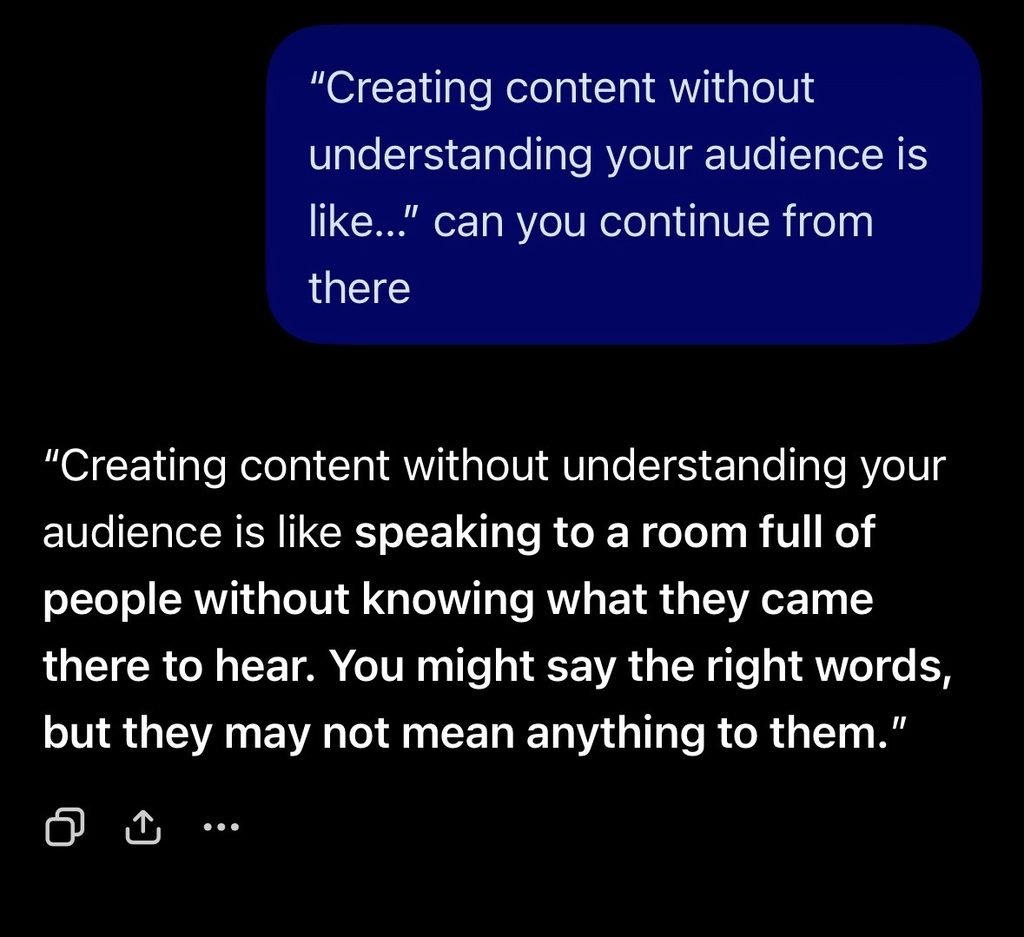
This is the simplest example I could provide. Like this, AI can predict and make everything look perfect. But the whole point of content marketing is to be unpredictable. To challenge the reader, to think deeper, and then make the decision. This is the most generic example that AI could generate and give. AI can never understand humans; only humans can think of creating that connection.
The Need for Human Creativity
There is a limit to which AI can function, because it can only do the tasks according to how it is trained. AI is mostly created to reduce time consumption, and it provides most of the help with brainstorming and structures. We still have to use our brains to create a connection, to stand out amidst competitors.
Brand Storytelling and Use of Emotional Connection
Storytelling is an important part of content writing. The story is about the audience, the problems they face, and how the brand solves those problems. It’s seen that AI tends to be empathetic, but it doesn’t actually understand the real problem here. AI is pre-trained to understand patterns from the words given, but can it really understand the emotion behind them? If you really tell the problem you are facing to ChatGPT, it can give you a very positive response without really understanding what you are actually going through.
AI can provide information about a buyer persona using data and automation, but the real essence comes when real experiences are shared: the trials and errors, the struggles, and the emotions behind them.
Google’s “Dear Sydney” ad faced backlash because it showed a father using AI to write his daughter’s fan letter to Olympic athlete Sydney McLaughlin-Levrone. Critics argued that the ad missed the point of a personal letter: its value comes from the child’s own words, feelings, and effort, not from an AI-generated draft. By presenting AI as a substitute for that authentic expression, Google appeared to endorse replacing a meaningful human moment with automation. Although AI can be useful for brainstorming and drafting, it should support personal communication rather than speak in someone’s place.
Real-World Awareness
AI does not always understand the world around us. It may not recognize when a joke could offend someone, when a word has a different meaning in another culture, or when an idea does not fit the real situation.
For example, Google’s Gemini generated an advertisement for a small Wisconsin cheese business that described Gouda as making up 50–60% of the world’s cheese consumption. The claim was inaccurate, so Google removed it from the advertisement. This example shows that AI can produce convincing content without understanding whether the information is realistic or appropriate for the audience.
This is why human marketers still need to review AI-generated content. They must check the facts, consider the cultural context, and make sure the message fits the brand and its audience
Unique Brand Identity
Think about how each company has its own unique identity. Apple built its identity around simplicity, creativity, and innovation. Nike created a feeling of motivation and determination through its products and the message behind “Just Do It.” Spotify made music a form of self-expression through features like Spotify Wrapped.
These identities come from understanding people and having a clear idea of what the brand should stand for. They come from real people with real personalities.
AI can copy a brand’s voice if we give it enough examples, but it cannot decide what a brand should stand for on its own. It can also follow what has already worked instead of coming up with something completely new.
This is where human creativity still matters. Humans can take risks, understand culture, and come up with ideas that can make a brand different from the rest.
How Can AI Help In Content Marketing Exactly

1. Getting ideas when you feel stuck
Not everyone feels creative all the time. If you feel stuck, you can ask AI to give you 10 topic ideas, sample hooks, or even a sample draft to help you understand the structure.
But remember, you should never copy and paste what AI gives you. Use it only as a reference, then add your own ideas, experience, and creativity.
2. SEO assistance
AI can also help with SEO. It can help with keyword research, search intent, titles, meta descriptions, and article structure.
For example, if you are writing about audience research, AI can help you find related topics such as how to do audience research or how to create a buyer persona. You can then use these ideas to create your own content.
3. Data-driven personalization
AI can also help with data-driven personalization. It can look at a lot of data, find patterns, and help predict what type of content may work well. It can also help marketers create different messages for different groups of people.
For example, one group of customers may prefer educational content, while another group may prefer product-focused content. AI can help find these patterns and make the content more useful for each group.
AI can help marketers save time, understand their audience better, and make better content decisions. But the final creative decisions still need a human touch.
AI can give you ideas, but it does not have your personal experiences, emotions, or way of seeing the world. That is where human creativity comes in.
A good piece of content is not always the one that follows what has worked before. Sometimes, the best ideas come from trying something new or taking a risk. Humans can understand culture, emotions, and what people actually connect with.
So, AI can help you get started, but the final idea should still come from you. Use AI to support your creativity, not replace it.